As featured in GOLD by IMH
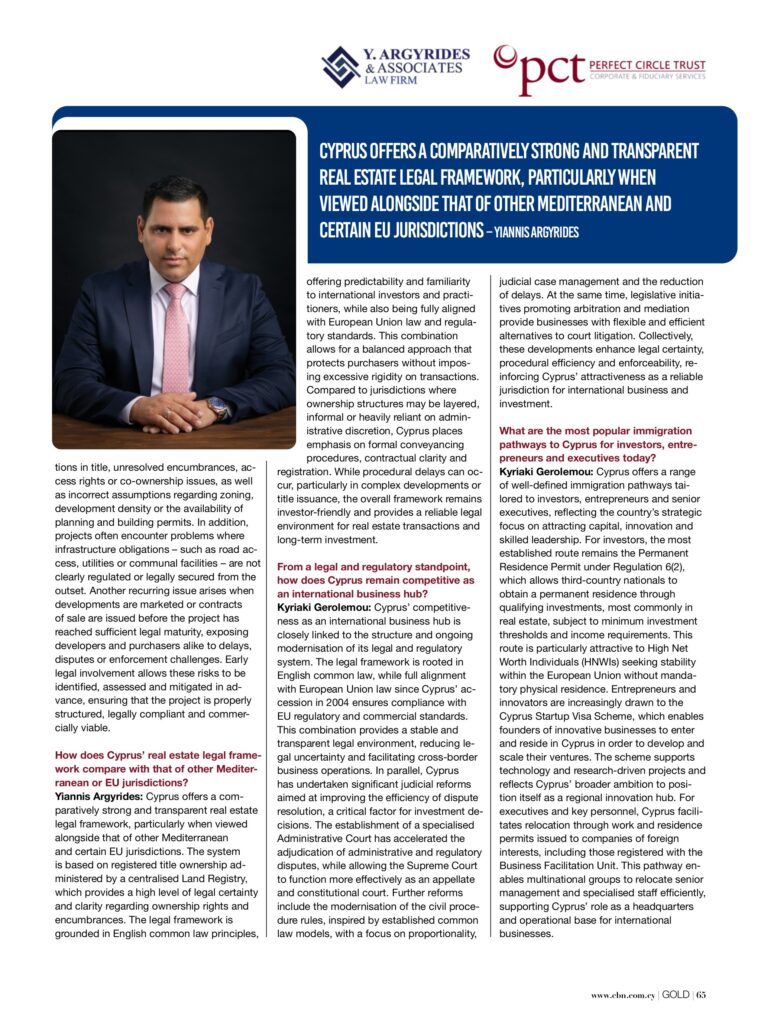
Y. Argyrides & Associates LLC was featured in a recent publication discussing Cyprus real estate, legal representation, and investor confidence.

Y. Argyrides & Associates LLC was featured in a recent publication discussing Cyprus real estate, legal representation, and investor confidence.

Buying property in Cyprus has become one of the most sought-after real estate investments in Europe. Demand from international buyers has been on a sustained upward trajectory, driven by Cyprus’s competitive tax environment, its status as an EU member state, and its enduring appeal as a Mediterranean lifestyle and business hub.
Foreign nationals — particularly from Israel, the United Kingdom, the Middle East, and increasingly the United States —view Cyprus real estate as a sound and strategically attractive investment.
The Cyprus property purchase process is, however, legally and technically complex. Whether you are a foreign investor buying a luxury villa, a family acquiring a primary residence, or a company purchasing commercial premises, the risks of proceeding without qualified legal representation in Cyprus are significant and potentially costly. This article sets out the key matters to consider at every stage of a Cyprus property transaction, whilst reflecting on current legislation, tax rules, and regulatory requirements as of 2026.
A. TYPES OF CONVEYANCING TRANSACTIONS
It is necessary to differentiate between the various types of properties, as each one carries particular legal considerations which must be addressed before the transaction is concluded. Broadly speaking, the main categories are:
B. GENERAL OBSERVATIONS: INVESTIGATING THE VENDOR
Prior to engaging with and finalising a transaction with any vendor, the following matters concerning the vendor themselves must be carefully investigated:
C. DUE DILIGENCE: WHAT TO CHECK BEFORE BUYING PROPERTY IN CYPRUS
One of the most important services a Cyprus property lawyer provides is comprehensive due diligence before any contract is signed. In our practice we have completed numerous property transactions over many years. The following sets out the principal matters which must be investigated prior to concluding any conveyancing transaction in Cyprus, and in particular when purchasing off-plan. This list is not exhaustive but covers the vital issues most frequently overlooked by buyers proceeding without legal representation:
Every property purchased in Cyprus must be specifically described on the title deed, with its surface area clearly indicated. A Cyprus title deed confirms that the property has been erected lawfully and in accordance with the issued permits and licences. We strongly advise against purchasing any property for which no separate title deed has been issued, unless a certificate of final approval exists or the competent authorities confirm in writing that there are no obstacles to the issuing of separate title deeds.
The absence of a separate title deed is one of the most common problems encountered by foreign buyers in Cyprus and has historically caused significant legal and financial complications. In many instances, properties have been erected illegally, without the necessary licences, or extend into neighbouring plots or beach protection zones. A valid title deed offers essential protection against such dangers. Always request a newly issued certified copy of the title deed, as older versions may not reflect the most recent entries, such as recently registered mortgages, prohibitions, or other encumbrances.
Before entering into a contract for an off-plan property, the potential purchaser should confirm that the developer has obtained both a Planning Permit and a Building Licence. The purchaser should also request and review the specific conditions attached to these permits and the authorised architectural plans.
Upon completion of construction, the developer should provide the purchaser with a signed declaration by the overseeing architect or civil engineer, confirming that the property has been completed in accordance with the terms of the relevant permits and the approved plans.
Payment should be linked to the construction stages, and a percentage of the purchase price should be paid only when the certificate of final approval has been issued.
Consideration must be given to the quality of the property and the possible existence of latent defects or structural damage. It is strongly recommended that the purchaser retains an independent architect and/or civil engineer to carry out a structural survey prior to exchange of contracts, in order to evaluate and establish the safety, soundness, and condition of the property. Your lawyer should advise you accordingly.
It must be established that the property, as it physically exists, corresponds to its description on the title deed and the approved plans. Any discrepancy may indicate that unauthorised work has been carried out, which may be noted on the title deed and may prohibit the transfer of ownership. Your lawyer should confirm whether all additions or alterations have been duly authorised by the competent authorities.
It is extremely important to investigate whether any mortgages, memos, prohibitions, open files, third-party rights or other encumbrances are registered against the property. Such encumbrances take priority in the order in which they were registered. If pre-existing charges encumber the property, it will not be possible to transfer ownership to the purchaser free of encumbrance unless all such charges are first discharged or released. Enquiries must also be made as to whether the property is affected by any development plans (e.g. road construction) or compulsory acquisition orders.
Any person who is neither a Cypriot citizen nor a citizen of a European Union Member State must apply for and obtain permission from the Council of Ministers prior to registering immovable property in their name. This applies to both residential and commercial property. Where no separate title deed has been issued, it is essential that the application is accompanied by the building licence and the approved architectural plans. Note also that third-country nationals may not register undivided shares (co-ownership interests) in land unless related; they may only register the entirety of the ownership. Your lawyer must lodge the application and guide you through this process.
Where the property forms part of a communally managed building or development (e.g. an apartment block), the vendor must produce a declaration issued by the management committee evidencing that all communal fees owed up to the date of transfer have been settled in full. If such fees remain outstanding at the time of transfer, the new owner may be held jointly liable for the arrears.
In relation to the purchase of land, the potential purchaser must establish whether there is legal and registered access to the plot, or whether it is landlocked. Enquiries should also be made as to the availability of water and electricity supply, and whether the parcel constitutes a registered plot or merely a share of a larger parcel which would need to be formally subdivided before it can be independently sold.
D. TAXES AND FEES WHEN BUYING PROPERTY IN CYPRUS
Understanding the full tax cost of a Cyprus property purchase is essential before entering into any agreement. For foreign buyers in particular, the interaction between VAT, transfer fees, and capital gains tax can be complex and depends significantly on the nature of the property, the buyer’s personal circumstances, and how the transaction is structured. Key taxes and charges are set out below.
VAT applies to the first sale of new residential and commercial properties in Cyprus. The standard rate is 19%. A reduced rate of 5% applies to new properties purchased by individuals as their primary and permanent residence in Cyprus, introduced by Law 42(I)/2023 and further refined by Law 55(I)/2024 and updated rules effective June 2025. The reduced rate is not available to companies, which are always subject to the full 19%.
The 5% reduced rate is subject to a multi-layered set of conditions based on the property’s size, value, and the purchaser’s personal circumstances. Understanding how these conditions interact is one of the most frequently misunderstood aspects of buying property in Cyprus and is an area where your lawyer’s advice is essential.
For families with more than three children, the maximum eligible covered area is increased by 15 m² for each additional child beyond the third. For example, a family with five children benefits from a maximum area of 220 m² (190 m² + 15 m² + 15 m²), and the proportion of the purchase price eligible for the 5% rate is calculated accordingly.
Individuals with disabilities are entitled to the reduced 5% VAT rate on the first 190 m² of their primary residence, rather than the standard 130 m² ceiling.
Resale properties, and properties for which planning permission was granted before 1 May 2004, are generally not subject to VAT. For foreign buyers in Cyprus, the interaction between VAT eligibility, property size, value, and family circumstances must be carefully calculated before any commitment is made.
Upon transfer and registration of a property at the Cyprus Land Registry, transfer fees are payable by the purchaser, calculated on the market value of the property as assessed by the Department of Lands and Surveys at the date of transfer. The standard rates are progressive:
There is a full exemption from transfer fees where the transaction is subject to VAT (at either the standard or reduced rate), eliminating double taxation on new property sales.
Where VAT does not apply — typically resale properties — transfer fees are charged at 50% of the standard rates, making the effective rates 1.5%, 2.5%, and 4% respectively. Purchasing property in joint names (e.g. by two spouses or co-investors) also reduces the effective transfer fee, as the property value is apportioned between co-owners for calculation purposes.
Note also that a levy of 0.4% on the proceeds from disposals of immovable property in Cyprus applies, payable by the seller, as introduced in February 2021.
Stamp duty on property transactions in Cyprus has been abolished with effect from 1 January 2026 under Law 239(I)/2025. All sale agreements, loan agreements, and related documents signed on or after 1 January 2026 no longer attract stamp duty. This is a significant and welcome reform for all parties to a Cyprus property purchase, reducing transaction costs and simplifying the conveyancing process.
Note that any document signed on or before 31 December 2025 — even if only by one party — remains subject to the old stamp duty rules under the Stamp Duty Law of 1963. Legacy contracts must still be properly stamped in accordance with those provisions; failure to do so may result in fines and penalties, particularly if the document is produced in legal proceedings or submitted to a public authority.
Capital Gains Tax is levied on the seller at a rate of 20% on any taxable gain arising from the disposal of immovable property situated in Cyprus, or of shares in companies whose assets consist principally of immovable property in Cyprus. The taxable gain is generally calculated as the difference between the disposal proceeds and the original acquisition cost (adjusted for inflation and allowable expenses including transfer fees, legal fees, and interest costs on related loans).
Individual sellers may benefit from lifetime CGT exemptions. The principal exemptions are:
Certain disposals are wholly exempt from CGT, including gifts between spouses, parents and children (including foster children), and gifts to charitable organisations or family companies.
E. TERMS OF THE SALE AGREEMENT
The sale agreement is the most critical document in any conveyancing transaction. All material matters must be clearly addressed and negotiated before the agreement is signed. From our extensive experience, the following elements are of paramount importance:
Deposits paid under agreements are generally refundable upon termination of the agreement unless proven damages are established. The parties’ intentions as to the treatment of the deposit in the event of breach or rescission by either party must be clearly expressed in the agreement. Provision may also be made for the deposit to cover legal fees, estate agents’ fees, and other costs if the purchaser is responsible for the breach.
Time for performance must be expressly agreed upon and, critically, stated to be of the essence. The agreement must specify the date on which the vendor is obliged to give vacant possession, the date of transfer of ownership, and — in the case of off-plan properties — the date by which the property is to be completed and separate title deeds issued. Without a clear and enforceable time provision, no specific performance may be ordered by the Court and the innocent party may be unable to terminate the agreement.
When purchasing off-plan, all technical specifications of the construction must be agreed upon in detail, including the basic unit cost of every material and fixture. This agreement on baseline costs will facilitate the calculation of any additional cost arising if the purchaser later requests substitutions or upgrades during construction.
Payment instalments should be directly linked to verifiable stages of construction. At each stage, the developer should provide the purchaser with a certificate issued by the overseeing architect or civil engineer confirming completion of that stage. A retention of between 2% and 5% of the total purchase price should be held back and released only upon the issue of a separate title deed in the name of the purchaser, or at least until the issuing of a final certificate of approval.
Development companies typically operate under a general brand name but sell through newly incorporated special purpose vehicles which own little beyond the plot of land on which the development is built. These entities may have insufficient assets to satisfy a damages claim. The purchaser should therefore require the parent or holding company to execute a guarantee agreement pursuant to which the selling company and the guarantor will be jointly and severally liable for any breach of contract. This is a critical protective measure which is often overlooked.
The sale agreement should provide for the payment of penalties by the developer in the event of delays in delivering the property, typically calculated by reference to the market rental value of the property for each month of delay. Without such a provision, the purchaser’s only remedy may be limited to a claim for general damages, which are difficult to quantify and enforce.
The sale agreement should contain specific provisions addressing what is to occur if the purchaser — being a third-country national — is refused permission by the Council of Ministers to register the property in their name. In such a case, the agreement could provide the purchaser with a right to assign their interest to a third party, provided the full purchase price has been paid. Alternatively, the agreement should specify that it will be treated as frustrated and any moneys paid are to be returned to the purchaser, unless the vendor can demonstrate that damages have been sustained.
F. PERMANENT RESIDENCY BY INVESTMENT
The Cyprus Permanent Residency by Investment Programme (Category 6.2 of the Aliens and Immigration Regulations), commonly referred to as the Cyprus Golden Visa, remains a significant driver of foreign property acquisition in Cyprus. Non-EU, non-EEA, and non-Swiss nationals who invest a minimum of €300,000 (plus applicable VAT) in Cyprus real estate or other qualifying assets may apply for a permanent residency permit with a fast-track processing period of approximately two to six months.
Under the current programme:
It is important to note that the separate Citizenship by Investment Programme (“golden passports”) was suspended in November 2020 following concerns raised by the European Commission and is not available to new applicants. The Golden Visa programme should not be confused with that discontinued scheme.
Given the significant financial commitment and the strict documentary requirements of the programme, it is essential to obtain independent legal advice before proceeding with any investment made with a view to obtaining residency. Y. Argyrides & Associates LLC has extensive experience in advising and assisting clients through both the property acquisition process and the permanent residency application.
G. AML COMPLIANCE AND SOURCE OF FUNDS OBLIGATIONS
Cyprus has, in recent years, significantly strengthened its anti-money laundering (AML) and counter-terrorist financing (CTF) legislative framework, in line with EU Directives and the recommendations of the Financial Action Task Force (FATF). These developments have a direct and practical impact on every property transaction.
Law firms and lawyers in Cyprus are “obliged entities” under the Prevention and Suppression of Money Laundering and Terrorist Financing Law (Law 188(I)/2007, as amended). The Cyprus Bar Association is the designated supervisory authority for the legal profession. When a law firm acts in connection with a property transaction, it is legally required to:
Purchasers should therefore be prepared to provide their lawyers with full identity documentation, proof of address, and detailed evidence of the source of funds to be used for the purchase. Failure to provide adequate documentation will prevent the firm from acting. These are legal obligations and are non-negotiable.
Estate agents and other intermediaries involved in property transactions are also subject to AML obligations under Cypriot law. Any professional involved in the purchase or sale of immovable property is required to implement appropriate CDD measures.
H. THE ROLE OF ESTATE AGENTS: IMPORTANT CAUTION
We feel it necessary to address a practice which, unfortunately, persists in the Cyprus property market: some estate agents undertake to prepare sale agreements themselves without the involvement of a lawyer. This is not illegal under Cypriot, but must be firmly avoided. An estate agent has a vested commercial interest in completing the transaction and receives their commission only upon conclusion of a sale. They are neither qualified nor equipped to negotiate terms or include protective provisions on behalf of either party.
Similarly, certain development companies suggest that legal representation in conveyancing is unnecessary, a proposition which is, in our experience, invariably advanced in the interests of the developer rather than the purchaser.
I. WHY YOU NEED A PROPERTY LAWYER IN CYPRUS
Buying or selling property in Cyprus involves a wide range of legal, technical, financial, and regulatory considerations. Each of these, if not properly addressed from the outset, can have serious consequences. Foreign buyers in particular are frequently unfamiliar with the Cyprus conveyancing process, the Land Registry system, and the applicable legal requirements — making independent legal advice not just advisable, but essential.
Lawyers in Cyprus owe a duty of care to their clients, the standard of which has been held by the Courts to be that of a “usual, diligent and competent professional”. Under this duty, your Cyprus property lawyer is obliged to carry out all necessary due diligence, identify legal risks, and bring them to your attention. Failure to do so may give rise to a claim in professional negligence.
The legal fees for retaining an experienced Cyprus law firm to handle a property transaction are, without exception, disproportionately small when measured against the value of the transaction and the financial exposure which proper legal representation protects against. Our advice, without hesitation, is to retain a qualified conveyancing lawyer in Cyprus before entering into any commitment, whether as buyer or seller.
OUR EXPERTISE IN CYPRUS PROPERTY LAW
Y. Argyrides & Associates LLC — established in 1968 and recognised by Legal 500 and IFLR1000 — is a leading Cyprus law firm with extensive expertise in all aspects of Cyprus real estate law and property conveyancing. We act for Cypriot and international clients alike, including individual buyers, families, investors, and companies purchasing or selling property across Cyprus. Our services include:
For assistance and support please contact us at:
YIANNIS ARGYRIDES | Managing Partner
Email: yiannis@argyrideslaw.com | Tel: +357 24 655 360 | www.argyrideslaw.com
The content of this article is intended to provide a general guide to the subject matter and reflects the law and practice as at March 2026. Specialist advice should be sought about your specific circumstances. Any interested party should seek professional advice from their legal and tax advisors before proceeding with any transaction.

Y. ARGYRIDES & ASSOCIATES LLC FEATURED IN A PLACE IN THE SUN WEBSITE
We are excited to announce the listing of Y. Argyrides & Associates LLC on A Place in the Sun website, which we hope will be more than just a window to our law firm.
Y. Argyrides & Associates LLC has assisted thousands of clients throughout the years, especially UK nationals, who wished to establish themselves in Cyprus.
Our mission is to provide in-depth, high-quality, affordable legal advice and representation, efficiently and promptly whilst being accessible and approachable to clients.
You can find us on the website of A Place in the Sun by clicking here.
Please get in touch with us and see how we can assist you in safeguarding your legal interests when purchasing your dream home in Cyprus.
Y. Argyrides & Associates LLC – Law Firm

Y. Argyrides & Associates LLC is excited to announce the release of our corporate video which showcases our firm, the services and our people.
We hope that you like it as much as we do. Furthermore, we would like to express our thanks and appreciation to everyone involved with the production of this video.
We would love to hear your feedback, so please do watch and get in contact with us.

We are honored to have been featured by Forbes Magazine (Cyprus) in their October 2020 issue as a leading Law Firm.
The publication features an interview by our firm’s Managing Partner Mr. Yiannis Argyrides. Mr. Argyrides commented on the latest developments regarding the cancellation of the Cyprus Investment Program, the challenges that the legal profession is currently facing, and he also outlined our mission and vision for the near future.
We would like to thank Forbes Magazine for giving us the opportunity to present our Firm.
The full article can be read here.

The Republic of Cyprus and Russia had entered into a Double Tax Treaty (DTT) in 1998 in a joint effort to avoid the double taxing of income and capital generated in Cyprus. This was an effort to promote the economic cooperation between the two countries. Since its introduction, the DTT has been the catalyst for Russian investment in Cyprus, being an attractive jurisdiction with regards to its tax benefits.
On the 25th of March 2020, President Putin had introduced numerous measures in an attempt to tackle the fiscal challenges which were brought about by the coronavirus pandemic. Among the measures, he had announced the Russian Federation’s intentions to amend the Double Tax Treaties that are in place with various countries. Cyprus was the first country to receive an official notification on the 1st of April, 2020.
In his address, the Russian President instructed the government to initiate negotiations with foreign jurisdictions to amend Russia’s current DTTs and set the minimum withholding tax rate on dividends and interest payed from Russia at 15%. According to the Russian embassy in Nicosia, Cyprus had been selected as the first country for objective reasons, since 34% of the cumulative direct foreign investment in the Russian economy comes from Cyprus.
The proposed amendment to the DTT was the increase of withholding tax rates on dividend and interest payments from the current rates of 5% or 10%, to 15% capital of the Russian Company.
Cyprus through its Finance Minister Mr. Constantinos Petrides has managed to secure the continuation of the DTT by signing on 10th of August 2020 an amendment to the Cyprus-Russia double-tax treaty.
The Cypriot side ensured, the exemption from a 15 per cent withholding tax on dividends for regulated entities, such as pension funds and insurance companies, as well as listed companies. In addition, interest payments from corporate and government bonds as well as Eurobonds are excluded from the 15 per cent withholding tax in the new Cyprus Russia Double Tax Treaty. Any other type of Cyprus-based entities will still be able to avoid double taxation, but at a higher rate of 15 per cent.
In advance, the Russian side had assured the withdrawal of the termination procedures of the Convention. Furthermore, it assured that the same regulations will apply to other countries that maintain similar agreements from the same date that will apply to Cyprus, since it is a single fiscal policy. The signing will probably coincide with the arrival on the island of Foreign Minister Sergey Lavrov in September or October 2020.

The Government of the Republic of Cyprus has announced its decision to speed up the processing of ongoing applications for the Cyprus Investment Program. This adjustment will reduce the processing time significantly in an aim to boost the Cypriot economy in the wake of the ongoing coronavirus pandemic.
Several ideas have been submitted to the Cypriot President to further improve the credibility of the program. One main idea put forward is for developers to work alongside legal firms so as to have regulated lawyers involved in the process. This would ensure the smooth and swift processing of legal documentation while giving the applicant peace of mind that a highly creditable source is handling the application alongside the developer.
The Cyprus Government is now considering removing the cap on applications. As it stands the program only allows 700 naturalisations a year, however, this may soon change.
Another development is the adaptation of the program due to the pandemic. The Cyprus Government is now considering a procedure for remote applications to be submitted for the program. This will allow investors who are unable to leave their country of residence due to any restrictions, to still be able to apply to the program.
The speeding up of applications, the ability to apply remotely and the possible extension of the UK leaving the EU, presents a timely opportunity to high net worth individuals to participate in the Cyprus Investment Program.
For those interested in this unique opportunity but are possibly facing reservations regarding investments and construction of property in Cyprus, it is noteworthy to keep in mind the following:
The island of Cyprus continues to successfully manage the coronavirus pandemic so as to limit the effects on all main sectors of its economy, including the Real Estate and Development sectors. Due to the quick and decisive measures taken by the Government, Cyprus is now enjoying the benefits of businesses reopening and developments beginning to take shape once more.
The successful actions and sacrifices of the Cypriot people have not gone unnoticed, as Cyprus now ranks within the top 40 safest countries in the world and as the 14th safest country in Europe regarding the pandemic. The high standard of health and safety on the island is allowing Cyprus to prepare for the summer season that in turn will strengthen its economy. By efficiently handling the pandemic, Cyprus is now able to kick-start its economy ensuring a safe haven for people, businesses, investments and developments.
Y. Argyrides & Associates LLC features an established track of record in offering focused and comprehensive legal solutions to discerning high net worth individuals from across the world.
The firm boasts a deep and long-standing involvement in Cyprus’ Investment Program both in terms of the actual establishment and operation of the program on the island, as well as regrading assisting individuals to benefit from it.
The firm’s team is very experienced in handling applications for the Cyprus Investment Program. They go beyond the standard protocols, offering individually tailored and personalised service for each unique client, ensuring a smooth process of obtaining a Cyprus passport.
With a wide portfolio featuring a variety of different investment opportunities on the island and a comprehensive experience surrounding the application process for the acquisition of either citizenship or permanent residency permit on the island, Y. Argyrides & Associates LLC is the go-to firm for total peace of mind.
Our experienced team is eager to provide you with proven, trouble-free Investment & Citizenship services for you and your loved ones. We would be glad to disclose more information as well as offer our assistance. Feel free to get in touch with us by sending us an email at info@argyrideslaw.com.

Y. Argyrides & Associates LLC has had the pleasure of collaborating through the years with Ukrainian professionals and successfully representing Ukrainian organisations and individuals.
The list currently includes only 7 select legal firms island wide, with Y. Argyrides & Associates LLC being the only firm located in Larnaca.

Boasting an already attractive package as an international business and financial hub due to its unique location, modern infrastructure, accessibility, stability and great relationship with virtually all countries in the world, Cyprus has further advanced its unique position by fundamentally reforming its relevant trusts legislation over the years.
An increasing number of professionals chose Cyprus to set up their International Trusts due to the unique environment offered by Cyprus Law, which is based on the popular English law and principles to begin with. Nowhere else in the world can one find so many advantages concentrated in a single trust jurisdiction. The fact that Cyprus is a member of the European Union only adds to the already comprehensive package.
Some of the advantages of setting up trusts in Cyprus include:
Now let’s look into the Cyprus International Trusts Law in detail:
The law governing Cyprus International Trusts (the “CIT”) is the International Trusts Law of 1992, as has been amended from time to time (the “Law”). The Law aims to attract non-Cypriot Tax Residents for establishing a hereditary vehicle in the Republic of Cyprus in order to protect their properties/private assets located anywhere in the world including property situated in Cyprus, and simultaneously benefit by Cyprus tax regimes.
Who are the main participants of a CIT?
Can a CIT be irrevocable?
According to the Law, a CIT is irrevocable unless a specific power of revocation is clearly stated by the Settlor.
What is the applicable law and the respective court jurisdiction?
Pursuant to the provisions of the Law, the Settlor may choose the law which will govern the CIT. In cases where no applicable law has been chosen, then the CIT will be governed by the law which is more closely related to the CIT (the Law provides relevant guidelines in this respect).
Based on the provisions of the Law, the Cyprus Courts, if one of the following circumstances apply, shall have exclusive jurisdiction on a CIT:
What are the advantages of a Cyprus International Trust?
I. Settlor may reserve powers
According to the Law, the Settlor may reserve for himself certain powers/rights either in his capacity as Settlor, or as Protector or as Enforcer of the Trust, such as:
II. The CIT might be amended from time to time
The Law permits an alteration to the terms of the CIT if it is permitted by the CIT itself or after being approved by the Court.
III. The duration of the CIT
Provided that it is not otherwise indicated in the CIT, there shall be no limit on the period for which the trust is valid and enforceable.
IV. Confidentiality of CIT
First of all and most importantly, trust registers maintained by the competent authorities are not publicly available.
Furthermore, the Law prohibits the disclosure of any information or documents regarding the CIT by any person (including the Trustee). Only the court may allow such disclosure of information/documents, to the extent that such disclosure is important to the result of a particular civil or criminal proceeding.
V. Taxation
Income or profits which are acquired or deemed to be derived from outside Cyprus are not taxable in Cyprus if the beneficiary is not a Cyprus tax resident. Income and profits sourced from Cyprus are taxable in Cyprus, irrespectively if the beneficiary is a Cyprus tax resident or not. Nevertheless, all income and profits of a CIT which are acquired or deemed to be derived from sources inside or outside Cyprus are taxable in Cyprus provided that the Beneficiary is a Cyprus tax resident.
Passive income (dividends/passive interest) received by a CIT from a Cyprus company are not subject to tax nor subject to withholding tax.
VI. Asset Protection
The Law provides that notwithstanding the provisions of any bankruptcy or liquidation laws in the Republic or in any other country, unless it is proven to the court that the CIT was established with intent to defraud the creditors of the Settlor, the CIT shall not be void or voidable.
Y. Argyrides & Associates LLC feature an established track of record in offering comprehensive business & legal solutions to international and local businesses here in Cyprus.
With decades’ worth of experience and the establishment of countless trusts for its clients, the firm is in the unique position to advice multinational clients as to the creation of trusts as well as to the choice of the best possible structure.
Furthermore, the firm may draft the trust instrument and any other legal document required under the Law.
Y. Argyrides & Associates LLC supports and assists clients in terms of provision of trustee, administration and management services for the CIT.
Lastly, the firm advises clients regarding any issue related to trusts under the Law, trustee powers, beneficiary rights, interpretation of trust deeds and other trust related documentation and represents them in court.
Our experienced team is here to provide you with comprehensive services in all aspects of your business including setting up international trusts. We would be glad to disclose more information as well as offer our assistance. Feel free to get in touch with us by sending us an email at info@argyrideslaw.com.

Seeking to strengthen and solidify Cyprus’ unique position as an attractive global business hub as well as to increase awareness and establish connections with leading world-renowned businesses, the partners of Y. Argyrides & Associates LLC and Perfect Circle Trust LTD, Yiannis Argyrides and Kyriaki Gerolemou have recently met with the High Commissioner of India to the Republic of Cyprus.
Mr. Argyrides and Mrs. Gerolemou were delighted to have personally met with Her Excellency, Ms. Madhumita Hazarika Bhagat at the High Commission of India in Cyprus, and are grateful for the productive conversation.
The meeting’s main focus was India’s relationship with Cyprus including opportunities in establishing a solid foundation for a long and fruitful cooperation. The benefits and need for professionals such as lawyers and accountants in making bilateral ties a success were also on the agenda.
Y. Argyrides & Associates LLC and Perfect Circle Trust LTD wish to thank HE Ms. Madhumita Hazarika Bhagat for her hospitality and time, and are looking forward to a long lasting collaboration both with the High Commission as well as with business professionals in India.
Cyprus and India have traditionally enjoyed excellent political and economic relations, based on a deep friendship, mutual respect and close cooperation with these relations only strengthening over time.
Influenced by the mutual support and the similarities in culture and traditions of the two countries, Cypriot and Indian entrepreneurs are seeking opportunities to build good, strong and lasting business relationships.
The Indian and Cyprus legal system administers the common law system. They have in fact, inherited the legacy of the legal system established by the colonial powers. Α bright example is that, the Cyprus Contract Law Cap 149 is very similar and to some extent identical to Indian Contract Law. As a result, there are many examples in Cyprus case law where the interpretation of Cyprus Contract Law Cap 149 is based on Indian sources.
At this age and time, India and Cyprus are keen on promoting and upgrading their bilateral relations, increasingly focusing on economic, scientific, technical and tourist cooperation.
Main bilateral institutional arrangements signed between the two countries:
Since the 1960s, the importance of economic development and economic relations between the two countries, has drawn much attention worldwide.
Cyprus and India have achieved many economic developments. As per the DIPP figures, Cyprus is the 8th top investor in India.
A double tax treaty was signed by Cyprus and India on 18 November 2016 and has been revised on 21/04/2017.
Capital Gains Tax
The agreement provides for source-based taxation for gains derived from the alienation of shares. Investments made before 1.4.2017 are “grandfathered” with the view that taxation of disposal of such shares at any future date remains with the contracting state of residence of the seller.
Withholding tax rates
Under the new treaty, the following withholding tax rates apply:
The above rates are relevant in the case of dividends paid from India. Cyprus does not impose withholding taxes except on Cyprus sourced royalty payments.
Fund opportunities
Cyprus fund industry is rapidly evolving, turning Cyprus into the new investment fund center in Europe. The Cyprus‐India treaty allows and promotes Indian investors to establish, in the Republic of Cyprus, tax efficient fund structures, under a highly regulated environment in line with European Directives and be benefit from Cyprus tax neutrality, speed and flexibility of the Cyprus fund sector.
India maintains a High Commission in Nicosia. Cyprus maintains a High Commission in New Delhi, which is jointly accredited to Bangladesh, Malaysia, Myanmar, Maldives, Nepal, Sri Lanka, Thailand and Vietnam.
Both Y. Argyrides & Associates LLC and Perfect Circle Trust LTD feature an established track of record in assisting in the establishment, development and growth of multi-national businesses here in Cyprus.
Strategically located only a short distance away from the island’s international airport, both offer unique accessibility to global clients.
Offering a client-centered approach, these boutique law firms are renowned for their personal and business oriented touch. The firms are well connected and well established in Cyprus and abroad, and offer a unique blend of high quality, specialized services in the Corporate and Banking sectors.
Looking forward to establishing your business in the Republic of Cyprus?
Our experienced team is here to provide you with conclusive services in all aspects of your business. We would be glad to disclose more information as well as offer our assistance. Feel free to get in touch with us by sending us an email at info@argyrideslaw.com.